Blog
BTU vs Watts: What's the Real Difference?
Both measure energy, but they answer different questions. Here's how to tell them apart and switch between them.
Published · Updated
What this comparison answers
BTU and watts do not measure the same physical quantity. A BTU is an amount of energy, while a watt is a rate of energy transfer. BTU per hour and watts are both power units and can be converted directly.
This guide breaks down the two units, shows where each one fits, and gives you the math to switch between them.
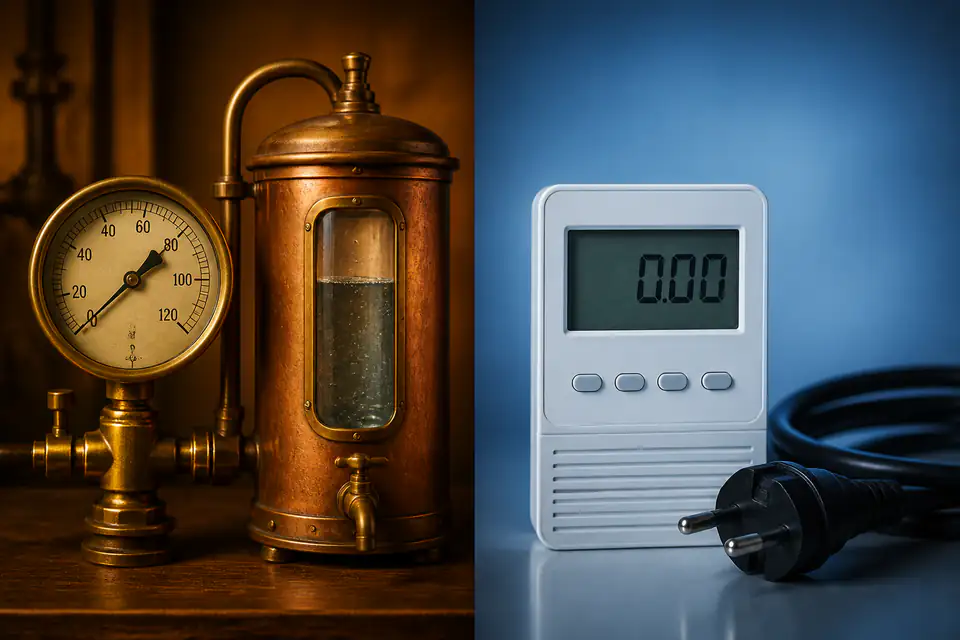
BTU, BTU/hr, watts, and watt-hours
| Unit | Measures | Time basis | Typical use |
|---|---|---|---|
| BTU | Energy | None | Heat or fuel energy |
| BTU/hr | Power | Per hour | HVAC heating and cooling capacity |
| Watt | Power | Joule per second | Electrical input or thermal output |
| Watt-hour | Energy | Power accumulated over time | Appliance energy use |
Match power with power and energy with energy. Convert BTU/hr to watts, or BTU to watt-hours. HVAC listings often shorten BTU/hr to BTU, so verify the label before doing the math.
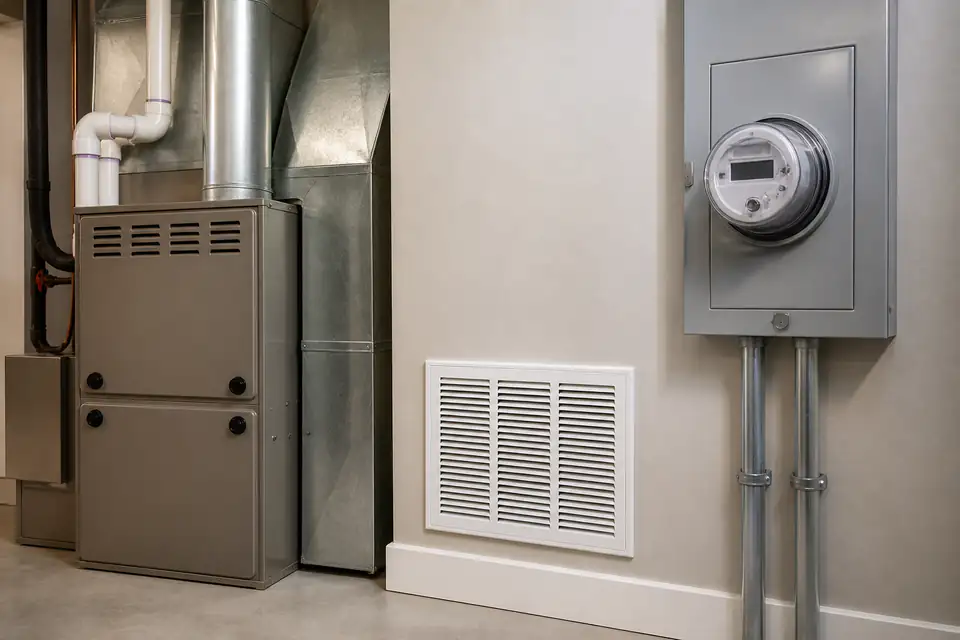
Thermal watts versus electrical watts
A watt is always a power unit, but it can appear on either side of a system. Thermal watts describe heating or cooling output. Electrical watts describe power drawn from the supply. An equipment label must identify which quantity it reports.
A resistance heater has a close input-to-room-heat relationship. An air conditioner or heat pump moves heat, so its thermal output can be greater than its electrical input. Furnaces and boilers may list fuel input, useful output, and auxiliary electrical demand separately. Capacity alone cannot determine appliance consumption.
What a BTU actually measures
BTU stands for British Thermal Unit. One BTU equals the heat needed to raise one pound of water by one degree Fahrenheit at sea level. It’s a unit of energy, not power.
The unit comes from 19th-century steam engineering. British and American engineers needed a way to rate boilers, furnaces, and stoves. Water was cheap, plentiful, and easy to weigh, so it became the reference. Today, the same number shows up on HVAC labels, gas appliance tags, and food calorie charts (a food Calorie is roughly 4 BTU).
You’ll see BTU printed on:
- Window and portable air conditioners
- Furnaces and gas heaters
- Wood stoves and pellet stoves
- Grills and cooktops
- Hot water heaters
Most appliance ratings use BTU per hour (BTU/h), not raw BTU. The “per hour” part turns the energy unit into a rate. A 12,000 BTU/h air conditioner removes 12,000 BTU of heat every hour it runs.
What a watt actually measures
A watt is the SI unit of power. One watt equals one joule per second. It tells you the rate of energy transfer at a single moment in time.
James Watt didn’t invent the unit, but his name got stamped on it for his work on steam engines. Engineers needed a way to compare engine output to horse-drawn machinery, and the watt grew out of that comparison.
Watts show up on:
- Light bulbs
- Computers and phone chargers
- Kitchen appliances (kettles, microwaves, toasters)
- Solar panels
- Electric motors
- Generators
Bigger numbers need a prefix. One kilowatt (kW) is 1,000 watts. One megawatt (MW) is one million watts. A typical home runs on about 1 kW of average power.
The side-by-side comparison
| Property | BTU (per hour) | Watt |
|---|---|---|
| What it measures | Heat transfer rate | Power |
| Origin | British engineering | SI / metric system |
| Common region | US, UK, Canada | Worldwide |
| Used for | Heating, cooling, gas appliances | Electrical devices |
| Energy unit form | BTU (no time) | Joule |
| Symbol | BTU/h | W |
Both are rates of energy flow when you write them as BTU/h and W. That makes them directly convertible.
The conversion number
One watt equals 3.412 BTU per hour. Flip it around and one BTU per hour equals 0.293 watts. The article on how many BTU/hr one watt equals derives that factor from joules and seconds.
Two examples:
- A 10,000 BTU/h portable AC pulls heat at the same rate as 2,930 watts of electric heating.
- A 1,500 W space heater puts out heat at 5,118 BTU/h.
The conversion is exact. The number 3.412 comes from the ratio of one BTU (1,055.06 joules) divided by one hour (3,600 seconds).
Why both units still exist
Some people ask why the US hasn’t switched to watts for everything. The answer is plumbing — literally. Gas lines, furnaces, water heaters, and boilers have used BTU ratings for a century. Building codes, contractor manuals, and replacement parts all reference BTU. Switching would mean rewriting thousands of standards.
Electrical gear went metric early. Edison and Westinghouse built their grids around volts, amps, and watts. The two worlds met in the middle, and now your house has both stickers on different machines.
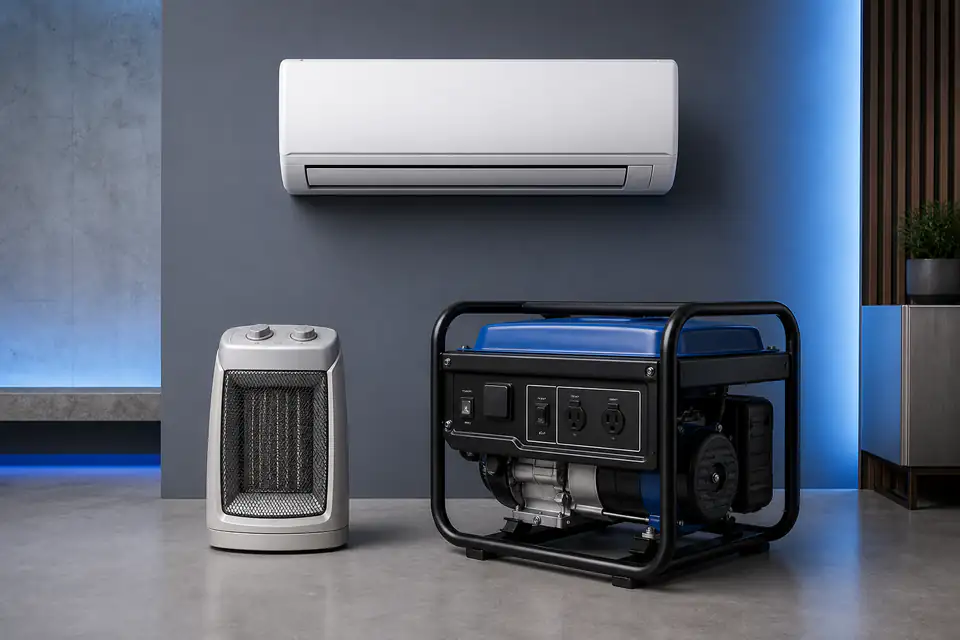
Where the distinction matters
Sizing an air conditioner
AC capacity is rated in BTU/h. A 5,000 BTU/h unit cools a small bedroom. A 12,000 BTU/h unit handles a living room. The same unit draws watts from your outlet — usually 400 to 1,500 W depending on efficiency. The BTU number is the cooling output. The watt number is the electrical input. Our guide to converting air conditioner BTU to running watts works through both numbers for common AC sizes.
The ratio between them is the EER (Energy Efficiency Ratio). EER = BTU/h ÷ watts. An EER of 12 means you get 12 BTU/h of cooling per watt of electricity. Higher is better.
Picking a heater
Electric heaters list watts. Gas heaters list BTU/h. To compare them fairly, convert one side. A 1,500 W electric heater outputs 5,118 BTU/h. A 20,000 BTU/h gas heater would need 5,862 watts of electric input to match it — about four times more.
That gap is why gas heat costs less per unit of warmth in most regions, even when electricity is cheap. The output measurement looks similar on paper, but the source matters.
Buying a generator
Generators are sized in watts (or kW). The appliances you plug into them might be rated in BTU/h. To check fit, convert BTU/h to watts, then add up the loads.
A 12,000 BTU/h window AC drawing 1,100 W needs a generator that can spike to 3,000 W on startup. The BTU number tells you nothing about that spike — you need the watt rating from the appliance label.
Common mistakes
Treating BTU as instant power.BTU alone is energy. BTU per hour is power. The “/h” matters. Drop it and the math falls apart.
Adding electric and gas BTU directly.A 1,500 W heater and a 20,000 BTU/h gas heater don’t combine to “25,118 BTU/h” of useful comparison without context — they have different efficiencies and operating costs.
Forgetting the conversion isn’t 1:1 with electricity costs.A 5,000 BTU/h AC isn’t the same as 1,465 W of electric heat in your bill. The AC moves heat (high efficiency); the heater creates it (lower efficiency per dollar).
Quick reference
- 1 W = 3.412 BTU/h
- 1 BTU/h = 0.293 W
- 1 kW = 3,412 BTU/h
- 12,000 BTU/h ≈ 1 ton of cooling ≈ 3,517 W
Keep those four lines on a sticky note and you’ll handle most appliance sizing without a calculator. For specific values, use the BTU/hr to kW converter or the BTU/hr to tons converter.
The short answer
BTU rates heat. Watts rate power. Both describe energy flow, just in different languages. One came from steam and water, the other from electricity and physics. Once you know the 3.412 ratio, you can move between them in seconds.
Frequently Asked Questions
Is BTU/hr a unit of power?
Yes. BTU/hr measures thermal energy transferred per hour.
Are BTU/hr and watts directly convertible?
Yes. One BTU/hr is approximately 0.293071 watts.
Is BTU the same as BTU/hr?
No. BTU is energy; BTU/hr is power.
Are watts and watt-hours the same?
No. Watts measure power, while watt-hours measure energy over time.
Does converting AC capacity show electricity use?
No. It gives equivalent thermal watts. Use rated input and efficiency data for electrical consumption.