Blog
How to Convert BTU to Watts (Formula + Worked Examples)
The formula takes one division. Here's the walkthrough, worked examples, and what to watch for.
Published · Updated
Why people convert
You’ve got a BTU number and you need watts. Maybe the AC label shows 12,000 BTU/h but your generator is rated in kilowatts. Maybe you’re comparing a gas heater to an electric one and the marketing teams refuse to use the same units. Either way, the conversion takes one division.
This guide shows the formula, walks through worked examples, and points out the spots where people get it wrong. If you just need a number, the BTU to watts converter does the division for you.
What you are converting
A BTU (British thermal unit) is the heat needed to warm one pound of water by one degree Fahrenheit. It is an amount of energy. A watt is one joule of energy delivered each second. It is a rate.
Because one is an amount and the other a rate, raw BTU and watts can’t be converted directly. The number on an AC or heater label is almost always BTU per hour(BTU/h), which is a rate too — and that is what the formula below turns into watts. The BTU vs watts comparison covers the difference in more depth.
The formula
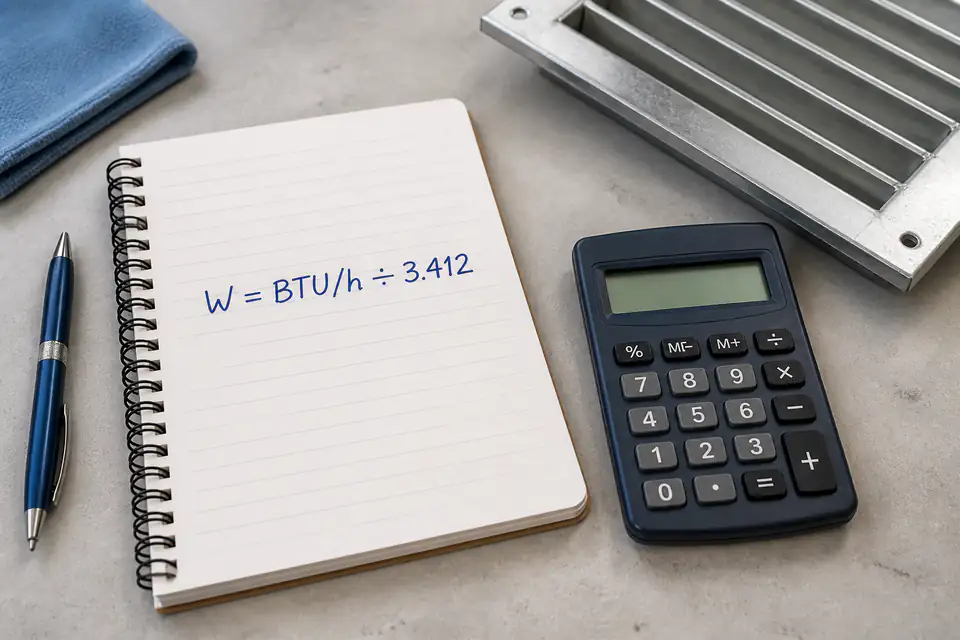
Watts = BTU/h ÷ 3.412
That’s it. One number, one operation. The factor 3.412 is fixed — it comes from the ratio of energy in one BTU (1,055.06 joules) to seconds in one hour (3,600).
For a precise answer, use 3.41214. For mental math, 3.4 is close enough.
The inverse direction:
BTU/h = Watts × 3.412
You’ll use both depending on which unit you start with.
Where the conversion factor comes from
One international-table BTU is approximately 1,055.05585 joules, one hour contains 3,600 seconds, and one watt equals one joule per second. Dimensional analysis makes the units cancel:
1 BTU/hr × 1,055.05585 J/BTU ÷ 3,600 s/hr ≈ 0.293071 J/s
Since J/s is W, one BTU/hr equals about 0.293071 W. Its reciprocal is 3.412142 BTU/hr per watt. This is why dividing by 3.412142 and multiplying by 0.293071 give the same result. The one-watt-to-BTU/hr breakdown walks through that reciprocal step by step.
Several slightly different BTU definitions have existed, including the thermochemical BTU and BTUs defined at a specific water temperature such as 59 °F. They differ by a fraction of a percent. HVAC ratings and this site use the International Table (IT) BTU, which is where 1,055.05585 joules comes from.
Choosing multiply or divide
| Direction | Formula |
|---|---|
| BTU/hr to watts | W = BTU/hr ÷ 3.412142 |
| BTU/hr to watts | W = BTU/hr × 0.293071 |
| Watts to BTU/hr | BTU/hr = W × 3.412142 |
The watt result should be numerically smaller than the BTU/hr input. Reverse the answer to check it. Keep the time denominator visible: BTU/min and BTU/sec use different factors and must not be entered as BTU/hr.
Step-by-step example
Start with a 9,000 BTU/h mini-split.
- Write down the BTU/h value: 9,000
- Divide by 3.412: 9,000 ÷ 3.412 = 2,638.3
- Round to a sensible figure: 2,638 W or 2.64 kW
The mini-split moves heat at a rate equivalent to 2,638 W of pure power. Its actual electrical draw will be lower — heat pumps are efficient — but the converted number is the cooling capacity expressed in metric units.
Five worked conversions
5,000 BTU/h → Watts
5,000 ÷ 3.412 = 1,466 W
A 5,000 BTU/h portable AC cools a 150-square-foot room. In metric terms, that’s 1.47 kW of cooling capacity.
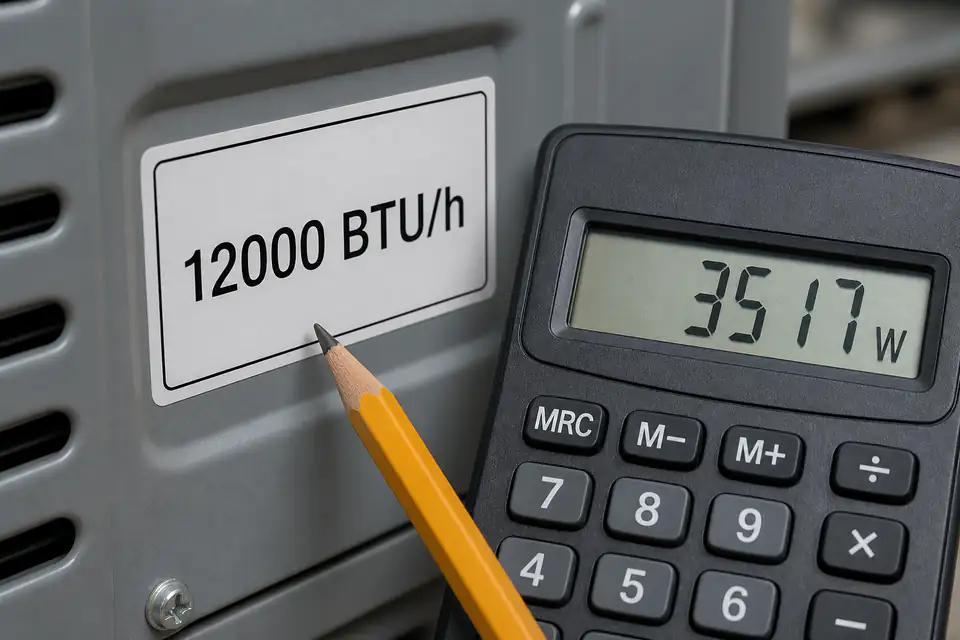
12,000 BTU/h → Watts
12,000 ÷ 3.412 = 3,517 W
A 12,000 BTU/h unit equals one refrigeration ton. The watt-equivalent is 3.5 kW, which lines up with how mini-split makers in Europe label the same hardware (a “3.5 kW unit” in Berlin is a “12,000 BTU unit” in Boston).
18,000 BTU/h → Watts
18,000 ÷ 3.412 = 5,275 W
Common size for a single-zone mini-split in a large bedroom or small living room.
24,000 BTU/h → Watts
24,000 ÷ 3.412 = 7,034 W
Two-ton system, often used for a small apartment or one floor of a house.
36,000 BTU/h → Watts
36,000 ÷ 3.412 = 10,551 W
Three-ton system. The metric label would read “10.5 kW.”
Doing the math in your head
Three shortcuts for fast estimates:
Divide by 3, then trim 12%.12,000 ÷ 3 = 4,000. Subtract 12% (about 480) and you get 3,520. The exact answer is 3,517. Close enough for shopping.
Use 0.293. Multiply BTU/h by 0.293 instead of dividing by 3.412. The two are mathematically identical. Multiplication is often quicker.
Memorize one anchor.1,000 BTU/h = 293 W. Scale from there. 5,000 BTU/h is 5 × 293 = 1,465 W. 10,000 is 2,930. 24,000 is 24 × 293 = 7,032.
When you need precision
For HVAC permits, energy audits, or engineering specs, the rounding matters. Use 3.41214 (or its inverse 0.29307107) when:
- Calculating EER or SEER ratings
- Filling out energy compliance forms
- Sizing electrical service panels
- Matching equipment across imperial and metric specs
For everyday shopping or back-of-envelope sizing, 3.4 or 3.412 is fine. The variation between AC units of the same nameplate rating is bigger than your rounding error.
Converting from kBTU and MBTU
Large equipment uses bigger units:
- 1 kBTU/h = 1,000 BTU/h = 293 W
- 1 MBTU/h = 1,000,000 BTU/h = 293,071 W = 293 kW
Watch out: in HVAC, “MBTU” usually means thousandBTU, not million. The Roman M (mille = 1,000) sticks around in old American engineering. A “100 MBTU furnace” is 100,000 BTU/h, not 100 million.
To avoid confusion, modern specs spell it out: “100,000 BTU/h” or “100 kBTU/h.”
Also don’t confuse kBTU with kW. A 24,000 BTU/h system is 24 kBTU/h, not 24 kilowatts. Convert first: 24,000 ÷ 3.412 = 7,034 W, or about 7.03 kW.
Related converters
Need to convert to a different unit? Use the BTU/hr to horsepower, BTU/hr to tons, or BTU/hr to MBH calculators.

Heating vs cooling: same math, different meaning
The formula works the same for both, but the result means different things:
- Heating BTU/h is the heat output of a furnace, boiler, or heater
- Cooling BTU/h is the heat removal rate of an AC or heat pump
A furnace rated at 80,000 BTU/h heats a house at 23,447 W of thermal output. An AC rated at 24,000 BTU/h cools at 7,034 W. Different directions, same conversion.
What the converted number is not
The watts you get from the BTU conversion is thermal output, not electrical input. Three quick checks:
Electric resistance heater:thermal output ≈ electrical input. A 1,500 W heater converts almost all its electricity to heat (5,118 BTU/h).
Air conditioner:thermal output > electrical input. A 12,000 BTU/h AC drawing 1,000 W from the wall outputs 3,517 W of cooling — three times its input. The trick is that it moves heat instead of creating it.
Gas furnace:thermal output < fuel input. An 80,000 BTU/h furnace at 90% efficiency burns 88,889 BTU/h of fuel. Some heat goes up the flue.
The conversion gives you the rated output. The wall plug or gas meter sees a different number.
Reading a product label
A window AC label might show:
- Cooling Capacity: 8,000 BTU/h— heat removed per hour
- Power Input: 715 W— electrical power drawn while running
- EER: 11.2— BTU/h of cooling per watt of input (8,000 ÷ 715)
Converting the 8,000 BTU/h capacity gives 2,345 W of cooling. The 715 W input is what the unit pulls from the outlet. Both are rates, but they describe different sides of the machine. The guide to air conditioner BTU and running watts shows how to estimate input power from EER or COP when the label leaves it out.
Real-world use cases
Picking a generator
A 12,000 BTU/h window AC draws roughly 1,200 W during operation. The converted figure (3,517 W) is the cooling output, not the electrical draw. To size a generator, use the watt label on the AC itself, not the converted BTU.
For an AC with no watt label, use this rule: divide BTU/h by 10 to estimate running watts. A 10,000 BTU/h unit pulls about 1,000 W. Startup surge can be 2 to 3 times higher.
Comparing electric and gas heaters
Electric heaters are sold in watts; gas and propane heaters in BTU/h. Put both on the same scale before comparing. A 1,500-watt space heater produces about 5,118 BTU/h. A 30,000 BTU/h propane heater is rated at nearly six times that (about 8,792 W), so the two are not interchangeable in the same room.
Comparing quotes from contractors
One contractor offers a “24,000 BTU heat pump.” Another offers a “7 kW heat pump.” Convert: 7 kW × 3.412 = 23,884 BTU/h. The two systems are nearly identical. Now compare prices and warranties. The BTU/hr to kW converter handles the math instantly.
Reading international specs
European spec sheets show heating and cooling in kW. American sheets show BTU/h. A “5 kW heating output” equals 17,060 BTU/h. A “2.5 kW cooling” equals 8,530 BTU/h.
A calculator worth using
Most online converters use the 3.412 factor. They differ in how many decimal places they show. For practical use, two significant figures past the thousand are fine: 12,000 BTU/h = 3,520 W, not 3,517.05 W. The extra digits are noise.
The method in one line
Take your BTU/h number, divide it by 3.412, and the answer is in watts. Multiply by 3.412 to go the other way. Memorize 1,000 BTU/h ≈ 293 W as an anchor and you’ll do the math in your head for the rest of your life.
Frequently Asked Questions
What is the BTU/hr-to-watts formula?
Watts = BTU/hr ÷ 3.412142, or BTU/hr × 0.293071.
Can BTU be converted directly to watts?
Only when a time basis is supplied. BTU alone is energy.
Why can I multiply by 0.293071?
It is approximately the reciprocal of 3.412142.
How can I check my calculation?
Keep units visible, estimate the magnitude, and convert the watt result back by multiplying by 3.412142.
Why do calculators show slightly different decimals?
They may use different precision, rounding stages, or formal BTU definitions.