Blog
How to Convert Watts to BTU (Formula + Examples)
The math is one multiplication. Here's the formula, worked examples, and what the answer really tells you.
Published · Updated
Why this conversion matters
Most electrical gear is labeled in watts. Most HVAC and gas gear is labeled in BTU. When the two worlds collide — sizing a heat load, comparing a space heater to a furnace, picking a backup generator — you need to flip watts into BTU per hour.
The math is one multiplication. This guide covers the formula, worked examples, and the cases where the number means something different than you’d expect. For a quick answer, plug your value into the watts to BTU converter.
The formula
BTU/h = Watts × 3.412
Multiply the wattage by 3.412 and you have BTU per hour. The factor is the same one used for the reverse conversion — it comes from the ratio of joules in a BTU (1,055.06) to seconds in an hour (3,600).
For higher precision, use 3.41214. For quick estimates, 3.4 is close.
The reverse:
Watts = BTU/h ÷ 3.412
Note the “per hour.” A watt is a rate, so the result is BTU/h, not BTU. The explainer on how many BTU/hr are in one watt covers why, and how watt-hours map to plain BTU. Going the other way? See how to convert BTU/h to watts.
Worked example
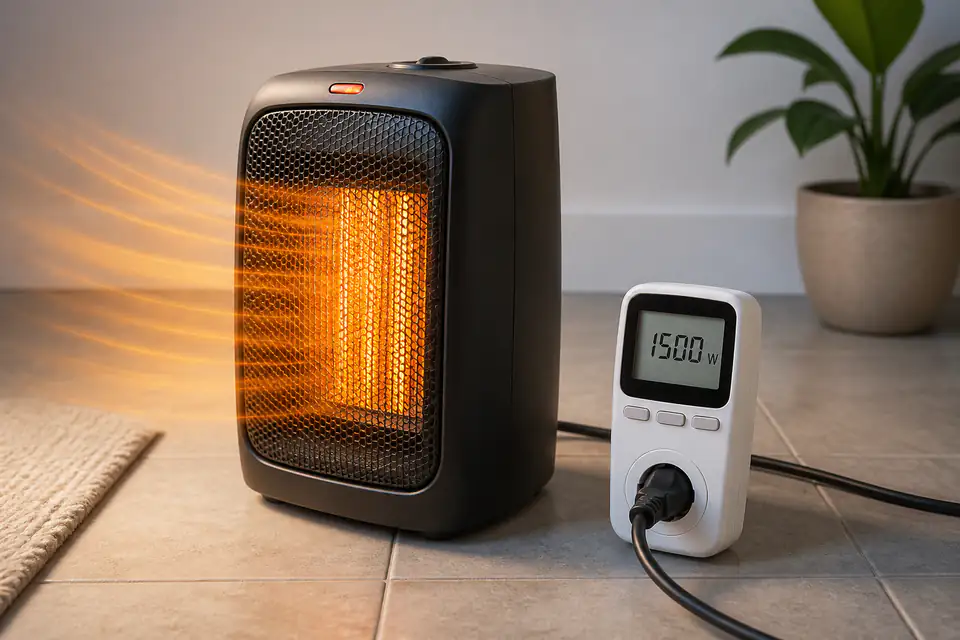
A 1,500 W space heater. What’s the BTU rating?
- Start with the watt value: 1,500
- Multiply by 3.412: 1,500 × 3.412 = 5,118
- Round: 5,118 BTU/h
A 1,500 W heater outputs 5,118 BTU per hour. That’s the heat delivered to the room, assuming standard resistance heating (close to 100% efficient at converting electricity to heat). The 1,500-watt heater guide adds running cost, amperage, and room-size context.
Common watt values
100 W → BTU/h
100 × 3.412 = 341 BTU/h
A 100 W incandescent bulb dumps 341 BTU/h into the room as waste heat. That’s part of why old lighting drove up summer AC bills.
500 W → BTU/h
500 × 3.412 = 1,706 BTU/h
A 500 W desktop computer adds roughly 1,700 BTU/h of heat to a room. Server rooms multiply this by hundreds — which is why data centers spend so much on cooling.
1,000 W (1 kW) → BTU/h
1,000 × 3.412 = 3,412 BTU/h
A 1 kW appliance running for one hour generates 3,412 BTU of heat. Memorize this — it’s the cleanest anchor for the conversion.
1,500 W → BTU/h
1,500 × 3.412 = 5,118 BTU/h
A nominal 15 A, 120 V circuit has a 1,800 W arithmetic rating, but allowable loading depends on whether the load is continuous, what else shares the circuit, applicable electrical rules, and the manufacturer’s instructions. Do not treat 1,500 W as a universal safe continuous-load limit.
5,000 W (5 kW) → BTU/h
5,000 × 3.412 = 17,060 BTU/h
Common rating for whole-house electric baseboard heating in a small room or for a hardwired electric heater.
10,000 W (10 kW) → BTU/h
10,000 × 3.412 = 34,120 BTU/h
Mid-size heat pump or electric furnace size.
Doing the math quickly
A few shortcuts:
Triple it and add 14%.1,500 × 3 = 4,500. Add 14% (630) to get 5,130. Exact: 5,118. Close enough.
Round to 3.4 for mental math.750 × 3.4 = 2,550 BTU/h. The exact answer is 2,559. The 9 BTU/h error doesn’t matter.
Use 1 kW = 3,412 BTU/h as the anchor. Scale up or down from there. 2 kW = 6,824. Half a kW = 1,706.
kW and MW
Watts come in three common scales:
- Watt (W) — small appliances, light bulbs
- Kilowatt (kW) — heaters, AC units, EV chargers (1 kW = 1,000 W)
- Megawatt (MW) — power plants, industrial sites (1 MW = 1,000,000 W)
Convert watts to BTU/hr: multiply by 3.412142. The watts to BTU/hr converter and BTU/hr to MW converter handle the math both ways.
- 5 kW = 17,060 BTU/h
- 10 kW = 34,120 BTU/h
- 50 kW = 170,600 BTU/h
For MW, the numbers get big:
- 1 MW = 3,412,000 BTU/h = 3,412 kBTU/h
- 10 MW = 34.12 million BTU/h
What the BTU number means
The result depends on what kind of device you’re converting:
Electric heater (resistance): the BTU number matches the heat output almost exactly. Every watt of electricity becomes a watt of heat. A 1,500 W heater produces about 5,118 BTU/h of room heating.
Heat pump: the watt rating on the nameplate is electrical input. The heat output is 2 to 4 times higher. A 1,500 W heat pump might deliver 15,000 to 20,000 BTU/h, not 5,118. The COP (Coefficient of Performance) sets the multiplier.
Air conditioner: same story in reverse. A 1,000 W AC pulls 1,000 W from the wall but moves heat at 3 to 4 times that rate. The BTU label on the box is the cooling output, not the electrical draw multiplied by 3.412. The air conditioner wattage guide explains how to get from cooling BTU/h to running watts.
Light bulb or computer: almost all the watts end up as heat eventually. A 100 W bulb adds 341 BTU/h to the room. A 65 W laptop adds 222 BTU/h. Useful when sizing AC for offices with lots of equipment.

Heat load calculations
Designers use watts-to-BTU conversion when sizing cooling for spaces full of electronics. The steps:
- Add up the wattage of every device that runs at peak
- Multiply by 3.412 to get BTU/h
- Add human body heat (about 400 BTU/h per person)
- Add solar gain through windows
- Total = cooling capacity needed
Example: a small office with five computers (200 W each), ten LED lights (10 W each), and three people.
- Computers: 5 × 200 = 1,000 W → 3,412 BTU/h
- Lights: 10 × 10 = 100 W → 341 BTU/h
- People: 3 × 400 = 1,200 BTU/h
- Subtotal: 4,953 BTU/h
- Solar gain (estimate): 2,000 BTU/h
- Total: 6,953 BTU/h
A 9,000 BTU/h mini-split would handle it with room to spare. For kVA loads (UPS, generators) use the kVA to BTU/hr converter since power factor changes the heat-output math.
Where the math doesn’t apply cleanly
The conversion is exact for energy quantities. It treats every watt as identical. Real-world equipment doesn’t always cooperate:
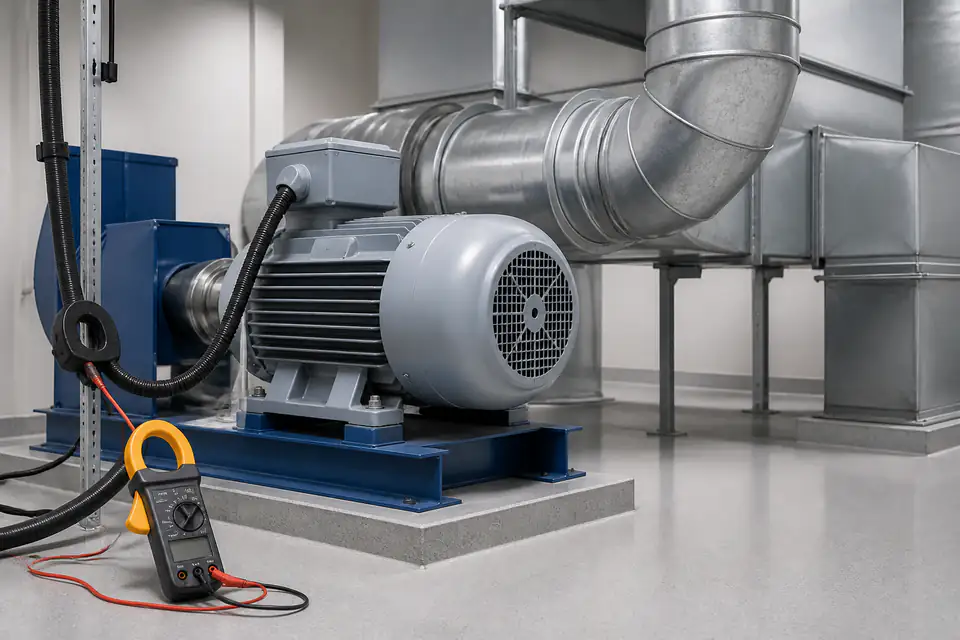
Motors with reactive power.A motor rated at 1 kW might draw 1.2 kVA from the wall due to power factor. The “real” power is still 1 kW, so the BTU conversion uses 1 kW. The apparent power matters for wiring and breakers, not heat output.
Variable-speed drives. A heat pump cycling between 30% and 100% output never sits at one wattage. The nameplate value is peak. Real-world heat delivery is lower on average.
Standby losses. A 1 kW heater rated for continuous operation might pull 1,005 W including controls. The extra 5 W shows up as heat anyway, so the BTU conversion is still accurate within rounding.
A reference table
| Watts | BTU/h |
|---|---|
| 100 | 341 |
| 250 | 853 |
| 500 | 1,706 |
| 750 | 2,559 |
| 1,000 | 3,412 |
| 1,500 | 5,118 |
| 2,000 | 6,824 |
| 3,000 | 10,236 |
| 5,000 | 17,060 |
| 7,500 | 25,590 |
| 10,000 | 34,120 |
Print it, tape it to your toolbox, never reach for a calculator again.
The whole method
Multiply watts by 3.412 to get BTU per hour. That’s the entire procedure. Keep 1 kW = 3,412 BTU/h in your head as the anchor and you’ll handle every other value by scaling. Watch out for heat pumps and AC units — their nameplate watts aren’t the same thing as their heat output.
Frequently Asked Questions
What is the watts-to-BTU/hr formula?
BTU/hr = watts × 3.412142.
How many BTU/hr are in one watt?
Approximately 3.412142 BTU/hr.
Is one watt equal to 3.412 BTU?
No. One watt equals about 3.412 BTU/hr; one watt-hour equals about 3.412 BTU of energy.
Can this formula estimate heat-pump output?
It converts a stated power value, but heat-pump output also depends on COP and operating conditions.