Blog
BTU to Watts for Air Conditioners
Convert cooling capacity correctly, then use efficiency and nameplate data to understand an air conditioner's real electrical demand.
A BTU to watts air conditioner calculation can describe two different things: cooling capacity or electrical input. An AC’s BTU rating normally means BTU per hour of heat removal. Dividing BTU/hr by 3.412142 gives the same cooling capacity in thermal watts, but those thermal watts are not the unit’s running watts. Use the BTU to watts calculator for the capacity conversion. To estimate electricity use, you also need EER, SEER, COP, or nameplate data. This guide explains common AC sizes, efficiency ratings, running and starting watts, and what to check before connecting an air conditioner to a generator, inverter, battery, or solar system.
What Does BTU Mean on an Air Conditioner?
A British thermal unit (BTU) is an amount of energy. BTU per hour (BTU/hr or BTUH) is a rate of energy transfer, so it measures power. On an air conditioner, the rating describes how much heat the system can remove from an indoor space each hour under specified conditions.
Manufacturers use BTU/hr because it is a familiar HVAC capacity unit in the United States. Product listings often shorten “8,000 BTU/hr” to “8,000 BTU.” In that context, they almost always mean hourly cooling capacity, not a one-time energy quantity. Checking the specification label removes the ambiguity.
Residential equipment ranges from small room air conditioners rated at several thousand BTU/hr to central systems rated in tens of thousands. The correct capacity depends on cooling load—not just floor area—and must account for climate, insulation, windows, ceiling height, humidity, occupancy, and heat-producing equipment.

What Do Watts Mean on an Air Conditioner?
On an electrical label, watts describe input power: how quickly the appliance draws electrical energy. Running wattage is the demand while the compressor and fans operate. Starting or surge wattage is the brief higher demand that may occur as a motor or fixed-speed compressor starts. Standby power covers controls and electronics when active cooling is off.
The compressor is usually the major load, but the indoor fan, outdoor fan, blower, pumps, and control board also consume power. A nameplate may list rated input directly in watts or kilowatts, or provide voltage and current. Average energy use over an hour can be lower than full-load wattage because the thermostat cycles a fixed-speed system or an inverter compressor reduces its speed.
Watts therefore need context. A cooling-capacity figure in watts is thermal output; a rated-input figure in watts is electrical demand. Watt-hours and kilowatt-hours then measure the energy consumed over a period of operation.
How to Convert Air Conditioner BTU/hr to Thermal Watts
Thermal watts = BTU/hr ÷ 3.412142
Thermal watts = BTU/hr × 0.293071
BTU/hr is the rated cooling or heat-transfer capacity. Thermal watts are that same power expressed in watts. The numbers 3.412142 and 0.293071 are reciprocal conversion factors: one watt is approximately 3.412142 BTU/hr, and one BTU/hr is approximately 0.293071 watts.
This is a unit conversion, not an electricity-use formula. It changes how the cooling output is expressed without adding information about the compressor, fan motors, efficiency, or electrical supply. Round only after completing the calculation.
Worked Example: 12,000 BTU Air Conditioner to Watts
12,000 BTU/hr ÷ 3.412142 = 3,516.85 thermal watts
Rounded to the nearest whole watt, a 12,000 BTU/hr air conditioner has about 3,517 thermal watts of cooling capacity. This rating is commonly associated with one refrigeration ton. Here, a ton is a cooling-capacity unit, not a unit of weight.
The result means the system can remove heat at a rate equivalent to 3,516.85 joules per second under its rating conditions. It does not mean the appliance draws 3,517 electrical watts. Because an AC moves heat through a refrigerant cycle, its electrical input can be lower than its cooling output. The amount depends on efficiency and actual operation, so use rated input or an applicable performance ratio.
Why Thermal Watts Are Not the Same as Running Watts
The evaporator absorbs heat indoors. Refrigerant carries that heat to the outdoor condenser, where it is released. The compressor drives the refrigerant cycle, while indoor and outdoor fans move air across the coils. Electricity powers this process; it is not converted into an equal quantity of cooling as it would be into heat in a resistance heater.
Thermal watts describe cooling output. Running watts describe input while the AC operates. Starting watts describe a short surge. Average hourly consumption reflects both power level and time: a thermostat may stop a fixed-speed compressor after reaching the setpoint, while a variable-speed system may continue at reduced output.
Indoor temperature, outdoor temperature, humidity, airflow, and coil condition all change the workload. Think of cooling capacity as the rate at which a pump can move heat and electrical wattage as the power needed to run that pump. Knowing one does not fully determine the other without efficiency data.
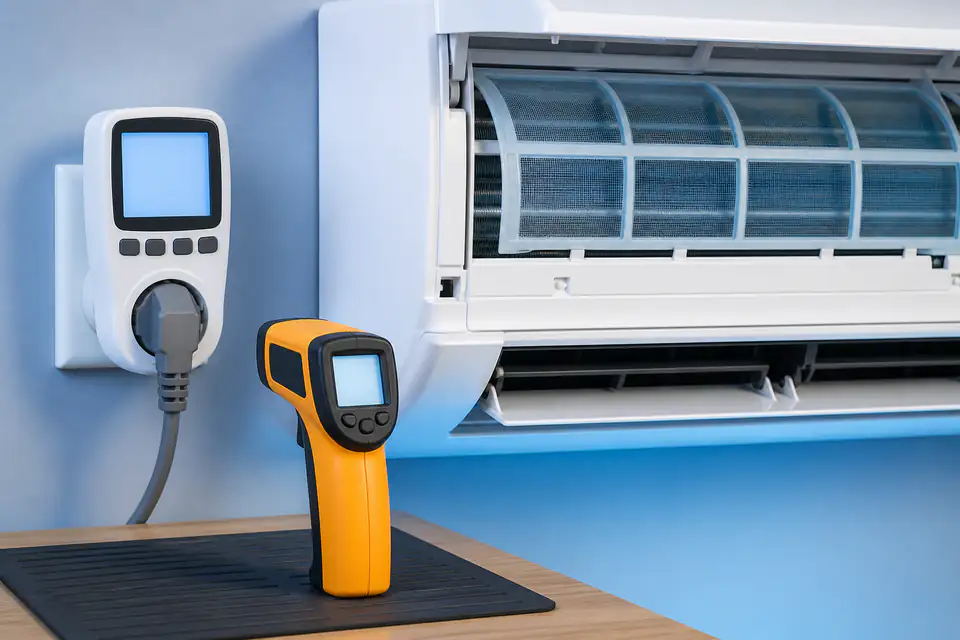
How to Estimate Actual Air Conditioner Wattage
Use the Rated Input Power
The nameplate, manual, or official specification sheet may state rated cooling input in watts or kilowatts. This model-specific value is the best starting point for operating demand. Check whether it covers the compressor alone or the whole system and whether separate indoor-unit or blower power must be included.
Use Voltage and Current
Watts ≈ Volts × Amps
This gives a basic estimate when voltage and current are known. For an alternating-current motor load, volts multiplied by amps gives apparent power; real watts may also depend on power factor. Current can vary with load, and variable-speed equipment does not have one constant draw. Use manufacturer input data when available.
Use EER
Electrical watts = BTU/hr ÷ EER
EER relates cooling output in BTU/hr to electrical input in watts at a defined test condition. For demonstration only, assume a 12,000 BTU/hr unit has an EER of 12: 12,000 BTU/hr ÷ 12 = 1,000 electrical watts. The EER is an assumption, not a manufacturer specification; substitute the actual rating for the model.
Use COP
Electrical watts = Thermal watts ÷ COP
COP is thermal output divided by electrical input when both use the same power units. A COP may refer to cooling or heating, so confirm the operating mode and test conditions. It can exceed 1 because a heat pump moves heat rather than creating all output from electrical resistance.
Use SEER Carefully
SEER measures seasonal cooling performance across changing test conditions and part-load operation. It is useful for comparing equipment, but it is not the same as instant EER and should not be inserted into the EER formula as a guaranteed running-watt value. Estimating seasonal energy requires climate, cooling demand, runtime, and the applicable rating procedure.
Common Air Conditioner Sizes and Thermal Watt Equivalents
| AC Capacity (BTU/hr) | Equivalent Thermal Watts | Common AC Type or Use |
|---|---|---|
| 5,000 | 1,465.36 W | Small window AC |
| 6,000 | 1,758.43 W | Bedroom window AC |
| 8,000 | 2,344.57 W | Window or portable AC |
| 10,000 | 2,930.71 W | Larger room AC |
| 12,000 | 3,516.85 W | Small mini-split or one-ton capacity |
| 18,000 | 5,275.28 W | Medium mini-split |
| 24,000 | 7,033.71 W | Larger split system |
| 36,000 | 10,550.56 W | Three-ton central AC capacity |
Values are rounded to two decimal places. The examples are context, not room-sizing rules; equipment type and suitable application vary by manufacturer, building, and climate. These are equivalent thermal watts, not guaranteed electrical draw. See the BTU to watts conversion chart for more values.

Typical Electrical Use by Air Conditioner Type
Window Air Conditioners
Window units commonly serve individual rooms and occupy the lower residential capacity range. Many use fixed-speed compressors that cycle on and off. Check the complete-unit nameplate for running input and startup information rather than converting capacity.
Portable Air Conditioners
Portable units combine the compressor and indoor fan in the room and reject heat through an exhaust hose. Hose and air-leakage losses can affect delivered room cooling, so two labels with similar capacities may not produce the same comfort or consumption. Compare ratings under the same standard.
Mini-Split Air Conditioners
A mini-split has indoor and outdoor units connected by refrigerant lines. Inverter compressors can vary speed, reduce hard-start behavior, and operate efficiently at part load. Actual input changes with demand. Heat-pump models can also reverse the cycle for heating.
Central Air Conditioners
Central systems combine an outdoor condenser with an indoor coil, blower, ducts, and controls. Electrical demand can include both the outdoor unit and indoor blower. Duct leakage and heat gain affect system runtime even when nominal cooling tonnage is unchanged.
Heat Pumps
A heat pump cools like an air conditioner and reverses operation in heating mode. COP and capacity change with conditions. In cold weather, auxiliary resistance heat can add a large separate load, so cooling-mode wattage does not describe every heating scenario.
How EER, SEER, and COP Affect Power Consumption
| Metric | What It Compares | Best Use |
|---|---|---|
| EER | BTU/hr cooling ÷ input watts | Approximation at a defined test condition |
| SEER | Seasonal cooling output ÷ seasonal energy input | Comparing seasonal efficiency |
| COP | Thermal power output ÷ electrical power input | Cooling or heating engineering calculations |
A higher EER means less input power for the same rated output at the relevant test point. A higher SEER indicates better seasonal performance under its rating procedure, but does not promise a fixed instantaneous wattage. COP uses like-for-like power units and may be greater than 1 because the equipment transports existing heat.
Ratings are most useful when comparing like equipment under the same standard. Real consumption still varies with load, weather, setpoint, installation, and maintenance.
How to Read an Air Conditioner Nameplate
Locate the permanent equipment label on the cabinet and match its model number to the manual. Depending on the manufacturer and country, the plate may show cooling capacity, rated input power, voltage, frequency, rated current, maximum current, compressor current, refrigerant type and charge, and an efficiency rating.
Larger equipment may also list minimum circuit ampacity and maximum overcurrent protection. Those are circuit-design fields, not running wattage. An indoor air handler and outdoor condenser may have separate labels, so system demand can require both sets of data.
Field names differ, and a maximum value should not be substituted for a nominal value without understanding the specification. Use the nameplate and manufacturer manual for electrical sizing, and obtain qualified electrical guidance for wiring or protection decisions.
Running Watts vs Starting Watts
A fixed-speed compressor can draw a short surge as it starts. Locked- rotor current, when supplied, describes a motor condition associated with that startup demand; it is not normal continuous current. Fans can add their own smaller startup loads, and cycling may repeat the event throughout the day.
Inverter compressors often ramp up more gradually and may reduce the surge, but behavior is model-specific. Generators and electrical inverters must support both continuous running demand and transient demand without unacceptable voltage drop or shutdown. Running watts alone may therefore be insufficient. Do not choose a power source from a BTU rating or a generic surge multiplier; use documented equipment and power-source specifications.
Can You Size a Generator or Solar System from BTU Alone?
No. BTU/hr tells you cooling capacity, not the complete electrical load.
Generator or inverter evaluation needs rated running watts, starting watts or current, voltage, current, power factor, compressor type, other connected loads, and an appropriate safety margin. A battery system also needs battery voltage, usable capacity, inverter losses, intended runtime, and discharge limits. Solar planning adds local production, panel orientation, weather, charge-controller limits, and the timing of cooling demand.
Climate and thermostat cycling affect energy consumption over time, but they do not remove the need to meet peak electrical demand. Check the AC nameplate, manual, generator or inverter documentation, and qualified electrical guidance before connecting equipment.
Factors That Change Real AC Electricity Consumption
Two air conditioners with the same BTU/hr rating can consume different amounts of electricity. EER, SEER, compressor design, fixed- or variable-speed control, fan power, and equipment age affect input. Installation and maintenance also matter: dirty filters, blocked coils, incorrect refrigerant charge, poor airflow, and duct losses can increase runtime or reduce delivered cooling.
The cooling load changes with room size, ceiling height, insulation, window area, sunlight, outdoor temperature, humidity, thermostat setting, occupancy, appliances, and air leakage. Operating hours turn power into energy consumption. A kilowatt reading describes power; kilowatt-hours on a bill describe accumulated energy.
Common Mistakes When Converting AC BTU to Watts
- Assuming BTU means BTU/hr. Confirm that the label states an hourly capacity.
- Calling thermal watts running watts. Use rated electrical input for operating demand.
- Ignoring EER, SEER, or COP. Efficiency connects cooling output with electrical input.
- Using SEER as an instant EER. SEER is seasonal and needs additional assumptions.
- Ignoring compressor surge. Check starting-current or surge documentation.
- Sizing a generator from capacity. Evaluate running and starting electrical loads.
- Comparing portable AC labels from different standards. Verify that the rating procedures match.
- Leaving out the fan or blower. Include all indoor and outdoor components.
- Confusing kW with kWh. Kilowatts measure power; kilowatt-hours measure energy.
- Expecting every 12,000 BTU AC to draw the same power. Design, efficiency, and conditions differ.
Related Air Conditioner and BTU Calculations
Use the main calculator for cooling capacity, or convert BTU to kilowatts for larger ratings. The BTU to refrigeration tons tool compares HVAC tonnage, while BTU to watt-hoursand convert BTU to joules handle energy rather than power. Read about the difference between BTU and watts if the unit types are unclear.
Frequently Asked Questions
How many watts does a 5,000 BTU air conditioner use?
5,000 BTU/hr equals 1,465.36 thermal watts. Actual electrical use depends on the model’s efficiency and rated input.
How many watts does an 8,000 BTU air conditioner use?
8,000 BTU/hr equals 2,344.57 thermal watts. Check the nameplate for electrical running wattage.
How many watts does a 10,000 BTU air conditioner use?
10,000 BTU/hr equals 2,930.71 thermal watts. That is cooling capacity, not guaranteed power consumption.
How many watts does a 12,000 BTU air conditioner use?
Its cooling capacity equals 3,516.85 thermal watts. An efficient AC draws less electrical power because it moves heat; use its rated input, EER, or COP for an estimate.
How many watts does an 18,000 BTU mini-split use?
18,000 BTU/hr equals 5,275.28 thermal watts, not electrical draw. An inverter mini-split changes input with load, so consult its performance data.
Does a higher BTU rating always use more electricity?
Not always in direct proportion. Capacity, efficiency, compressor control, installation, conditions, and runtime all affect consumption.
Can a 2,000-watt generator run an air conditioner?
BTU alone cannot answer that. Compare the generator’s continuous and surge ratings with the AC’s running and starting requirements and all other loads.
Is AC wattage the same as cooling capacity?
No. Thermal watts can express cooling capacity; electrical watts express power input. Always check which quantity a specification describes.
Where can I find my air conditioner's real wattage?
Check the equipment nameplate, manual, or official specification sheet. If only voltage and current are shown, their product is a basic estimate that may need a power-factor adjustment.
Does an inverter AC use fewer watts?
It can reduce input at part load by varying compressor speed, but savings are not universal. Sizing, climate, efficiency, controls, and installation determine real use.
Conclusion
An air conditioner’s BTU/hr rating measures cooling capacity. Dividing it by 3.412142 expresses that same heat-transfer rate in thermal watts. Actual electrical wattage is a separate input value shaped by efficiency, compressor operation, fan power, and operating conditions. Use the nameplate or manufacturer data for real input and starting requirements. The calculator makes capacity comparisons easy, but it does not replace electrical specifications or system design guidance.
Related Blog Posts
- BTU to Watts Calculator
Convert a rated heat-transfer capacity and review calculator guidance.
- How to Convert BTU to Watts
Review the conversion formula and worked examples.
- BTU to Watts Conversion Chart
Look up common thermal-power equivalents quickly.
- BTU vs Watts: What’s the Difference?
Compare energy, power, capacity, and electrical input.