Blog
How Many BTU Is 1,500 Watts?
The exact conversion, plus practical guidance for heater output, electricity use, amperage, room conditions, and safe operation.
If you are asking how many BTU is 1500 watts, the answer is approximately 5,118 BTU/hr. The “per hour” matters because watts and BTU/hr both measure power, while BTU alone measures energy. A 1,500-watt electric resistance heater therefore produces roughly 5,118 BTU/hr of heat at full rated power. Use the BTU to watts calculator in reverse mode for other watt values. Below, you will see the exact formula, what the output means for a room, how to estimate electricity cost and amperage, and the safety limits that matter with a high-load portable heater.
Direct Answer: 1,500 Watts in BTU/hr
1,500 W × 3.412142 = 5,118.21 BTU/hr
Rounded to the nearest whole number, 1,500 watts equals about 5,118 BTU/hr. This is a power conversion: it expresses the same rate of energy transfer in two different units.
Writing 5,118 BTU without a duration changes the meaning. A BTU is an amount of energy, but a watt is a rate. A 1,500-watt appliance running for one hour transfers 1.5 kilowatt-hours of energy and, for a resistance heater operating indoors, releases about 5,118 BTU of heat during that hour.
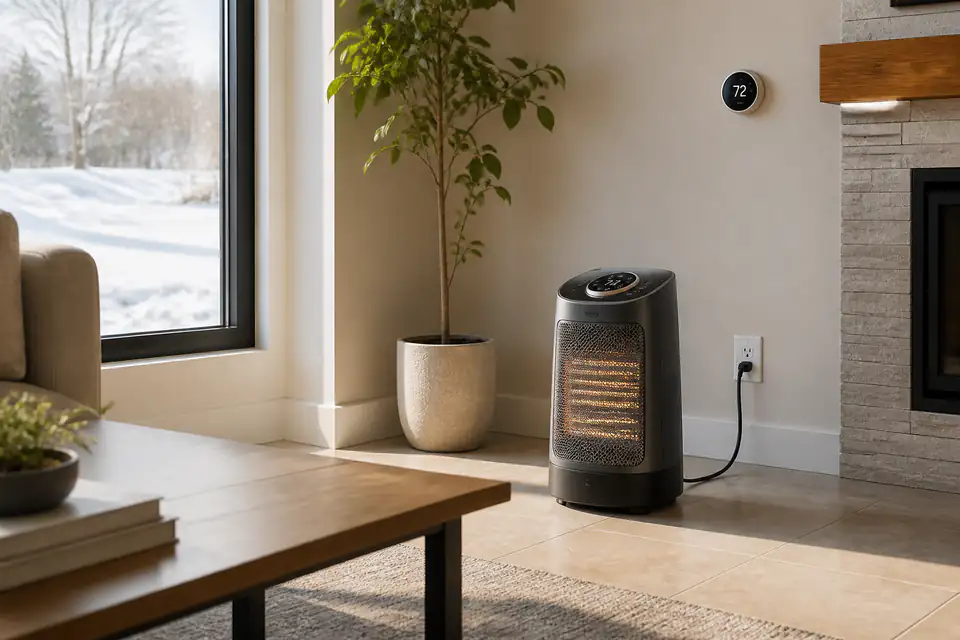
1,500 Watts to BTU/hr Formula
BTU/hr = watts × 3.412142
Watts are the starting power value. BTU/hr is the converted heat-transfer rate. The conversion factor is approximately 3.412142 BTU/hr for every watt. The displayed result may differ by a fraction if a calculator carries more decimal places before rounding.
The reverse formula is:
Watts = BTU/hr ÷ 3.412142
For more background on the reverse direction, see how to convert watts to BTU.
Step-by-Step Calculation
- Start with the rated power: 1,500 W.
- Multiply by the conversion factor: 1,500 W × 3.412142 BTU/hr per W.
- Calculate the result: 5,118.213 BTU/hr.
- Round to a useful precision: 5,118 BTU/hr.
Rounding removes digits that do not add practical value. It does not change the heater’s rated power; 5,118 BTU/hr is simply a clean whole-number version of 5,118.213 BTU/hr.
Does a 1,500-Watt Heater Produce 5,118 BTU/hr?
Yes. A 1,500-watt electric resistance heater produces about 5,118 BTU/hr while operating at full rated power. Current passes through a resistive heating element, and nearly all the electrical input eventually becomes heat inside the conditioned room. Energy used by an internal fan also ends up as indoor heat.
That does not mean the heater draws 1,500 watts every minute of the day. Its thermostat may cycle the heating element off after reaching the setpoint, reducing average energy use. Controls, placement, and airflow affect comfort and distribution even when total full-power heat output is similar.
Heat pumps work differently because they move heat and may deliver more thermal output than their electrical input. Gas heaters also need a separate combustion-efficiency calculation. The near one-to-one input/output relationship here applies specifically to electric resistance heating within the room.
What Room Size Can a 1,500-Watt Heater Heat?
There is no guaranteed room size for a 1,500-watt heater. Heating suitability depends on the room’s heat loss, not wattage alone. A small, insulated room in mild weather may retain heat well, while a similar floor area with drafty windows in a cold climate may lose heat faster than the heater can replace it.
A useful assessment considers outdoor temperature, climate, wall and ceiling insulation, ceiling height, windows, doors, air leakage, room exposure, floor type, occupancy, thermostat setting, and heater placement. Primary heating demands more certainty than occasional supplemental or spot heating.
Broad square-foot rules can help with an initial comparison, but they are not promises. A room-by-room heating-load calculation based on the building envelope and local design temperature gives a better answer.
1,500-Watt Heater Electricity Cost
Energy used (kWh) = Power (kW) × Operating time (hours)
Cost = Energy used (kWh) × Electricity rate
Since 1,500 watts equals 1.5 kW, continuous full-power use produces these energy totals:
| Operating Time | Energy Used |
|---|---|
| 1 hour | 1.5 kWh |
| 8 hours | 12 kWh |
| 24 hours | 36 kWh |
| 8 hours/day for 30 days | 360 kWh |
Multiply the applicable kWh figure by your local electricity rate. For example only, at $0.20 per kWh, one full-power hour costs 1.5 kWh × $0.20/kWh = $0.30. Eight hours costs $2.40, and 30 days at eight full-power hours per day costs $72. Use your own tariff, including time-of-use pricing where applicable. Thermostat cycling usually reduces element runtime, so actual consumption may be lower than a continuous-operation calculation.
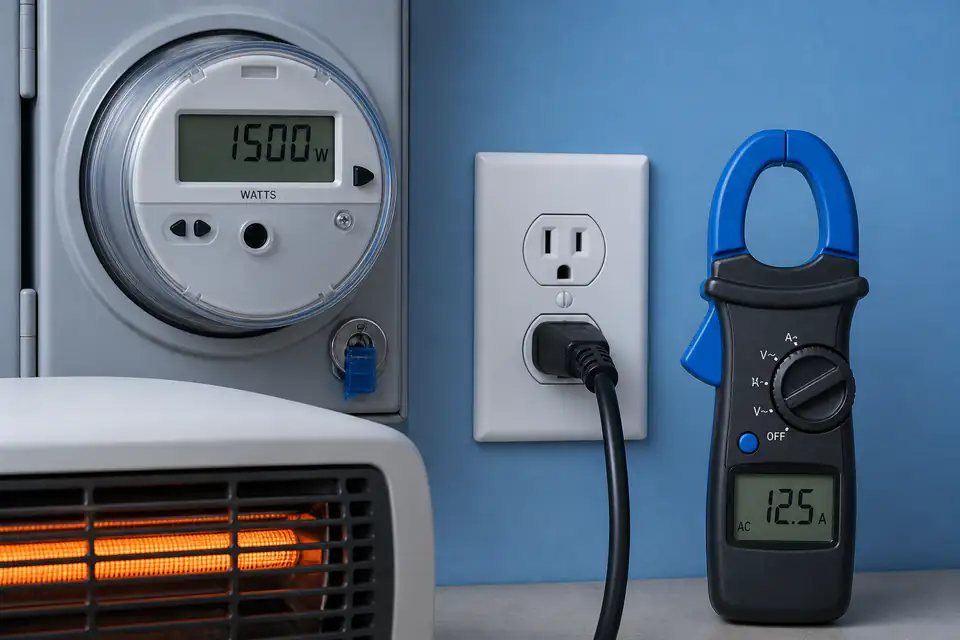
How Many Amps Does a 1,500-Watt Heater Use?
Amps = Watts ÷ Volts
1,500 W ÷ 120 V = 12.5 A
1,500 W ÷ 230 V ≈ 6.52 A
These are simple resistive-load calculations. Voltage standards vary by country, and the product label is the correct source for its rated voltage and current. Portable heaters are continuous high-load appliances. Follow the manufacturer’s instructions and local electrical rules; do not infer wiring or breaker requirements from these examples.
1,500-Watt Heater Safety
- Plug the heater directly into a suitable wall outlet when the manufacturer instructs you to do so.
- Do not use a damaged cord, plug, or loose outlet, and stop use if the plug or outlet becomes unusually hot.
- Avoid overloaded power strips. Treat extension cords cautiously and follow the heater manufacturer’s restrictions.
- Keep the required clearance from curtains, bedding, furniture, paper, and other combustible material.
- Place the heater on a stable surface where it cannot be easily knocked over.
- Prefer appropriate tip-over and overheat protection, and never defeat a safety control.
- Do not leave a portable heater unattended or use it near water unless it is specifically rated for that location.
Product-specific clearances and operating rules take priority. If an outlet, plug, cord, or breaker shows signs of overheating or damage, stop using the appliance and seek qualified help.
Common Types of 1,500-Watt Heaters
Ceramic Fan Heater
A ceramic element and fan move warm air quickly, making this design useful for short-term spot heating. Fan noise and direct airflow affect comfort.
Oil-Filled Radiator
Heated fluid and a metal body warm more slowly, then release heat steadily through radiation and natural convection. The sealed oil is a heat-transfer medium, not fuel.
Infrared Heater
Radiant output warms people and surfaces in its line of sight. It can feel immediate without first warming all the room air.
Convection Panel Heater
A panel warms air that rises naturally, creating quieter circulation without a strong fan-driven stream.
Fan-Forced Space Heater
A fan distributes heat rapidly through the room but adds airflow and noise. Grille placement and obstructions influence distribution.
At full power, all 1,500-watt resistance heaters produce roughly the same total heat. Their warm-up speed, surface temperature, airflow, noise, controls, and distribution differ, so they may not feel the same in use.
1,500 Watts Compared with Other Heater Sizes
| Heater Power | Approximate BTU/hr | Typical Use |
|---|---|---|
| 500 W | 1,706.07 | Personal or low-level spot heating |
| 750 W | 2,559.11 | Low setting on some portable heaters |
| 1,000 W | 3,412.14 | Moderate supplemental heating |
| 1,500 W | 5,118.21 | Full setting on many room heaters |
| 2,000 W | 6,824.28 | Higher-output heater where supported |
| 3,000 W | 10,236.43 | Larger fixed or commercial application |
Values are rounded to two decimal places. The use column provides general context only; it is not a room-size guarantee or electrical recommendation. See the BTU to watts conversion chart for more reference values.
1,500-Watt Heater vs Heat Pump
A resistance heater drawing 1,500 electrical watts delivers roughly 1,500 thermal watts, or 5,118 BTU/hr, inside the room. A heat pump uses electricity to move heat. With a coefficient of performance above 1, it can deliver more thermal watts than its electrical input.
Heat-pump capacity and efficiency change with outdoor temperature, operating mode, equipment design, and installation. Auxiliary resistance heat may also operate in some systems. Comparing both technologies by input wattage alone therefore misses delivered heat, conditions, and system behavior; it does not support a universal cost or savings claim.
Common Mistakes
- Writing 5,118 BTU. Use 5,118 BTU/hr for a power result.
- Confusing watts and watt-hours. Watts measure power; watt-hours measure energy over time.
- Promising one room size. Base suitability on heat loss and room conditions.
- Ignoring thermostat cycling. Rated wattage does not prove continuous runtime.
- Ignoring insulation and climate. Both strongly affect heating load.
- Using the wrong voltage. Read the product label before calculating current.
- Using an overloaded extension cord. Follow the manufacturer’s direct-outlet and cord instructions.
- Calling 1,500 W monthly energy use. Multiply 1.5 kW by actual operating hours.
- Comparing resistance heat and heat pumps by input alone. Compare delivered output and conditions.
- Treating a floor-area rule as a load calculation. Use building and climate data for sizing.
Related Conversions
The reverse formula converts BTU/hr to watts. For other scales and energy units, use BTU to kilowatts, BTU to watt-hours, convert BTU to joules, or BTU to therms. The difference between BTU and watts explains why energy and power units need the correct time basis.
Frequently Asked Questions
How many BTU does a 1,500-watt heater produce?
About 5,118 BTU/hr while an electric resistance heater operates at its full 1,500-watt rating.
Is 1,500 watts equal to 5,118 BTU?
Not as standalone units. The correct power equivalence is 1,500 W ≈ 5,118 BTU/hr.
Can a 1,500-watt heater heat a bedroom?
It may provide suitable primary or supplemental heat, but the answer depends on room size, insulation, windows, air leakage, ceiling height, and outdoor temperature.
How much electricity does a 1,500-watt heater use per hour?
At continuous full power, it uses 1.5 kWh in one hour. Thermostat cycling can reduce actual consumption.
How much does a 1,500-watt heater cost to run?
Multiply 1.5 kWh per full-power hour by your local electricity rate. Then adjust for actual runtime.
How many amps does a 1,500-watt heater draw?
The simple calculation gives 12.5 A at 120 V or approximately 6.52 A at 230 V. Use the heater’s rated voltage and label current.
Are all 1,500-watt heaters equally efficient?
Resistance models deliver roughly the same total full-power heat indoors, but controls, airflow, radiant output, and placement change comfort and runtime.
Can I use an extension cord with a 1,500-watt heater?
Follow the manufacturer’s instructions; many portable-heater instructions warn against extension cords. Never use an underspecified, damaged, coiled, or overloaded cord.
Is a 1,500-watt heat pump the same as a 1,500-watt space heater?
No. A heat pump can move more than 1,500 thermal watts using 1,500 electrical watts, while resistance heat stays near a one-to-one relationship.
What is the reverse conversion from BTU/hr to watts?
Watts = BTU/hr ÷ 3.412142.
Conclusion
1,500 watts equals approximately 5,118 BTU/hr, a conversion between two power units. A resistance heater produces roughly that heat output at full power, but room suitability still depends on climate and building conditions. Electricity cost depends on the 1.5-kW input, runtime, and local price. Check voltage, current, and safety directions on the product label, and use the main converter for other watt values.
Related Blog Posts
- How to Convert Watts to BTU
Use the watts-to-BTU/hr formula with any power value.
- BTU vs Watts: What’s the Difference?
Understand the difference between energy and power units.
- BTU to Watts Calculator
Convert other power values and review calculator guidance.
- BTU to Watts Conversion Chart
Compare common power values in both measurement systems.