Blog
How Many BTU Is One Watt?
The base conversion explained through power, energy, time, and practical heater and HVAC examples.
If you are asking how many BTU is one watt, the precise power conversion is 1 watt = 3.412142 BTU/hr. The answer includes “per hour” because a watt measures a rate of energy transfer, while BTU alone measures an amount of energy. Multiply watts by 3.412142 to get BTU/hr, or use the BTU to watts calculator in reverse. This article explains the factor, compares watts, watt-hours, BTU, and BTU/hr, and shows what the conversion means for heaters, electronics, air conditioners, and heat pumps.
Direct Answer: One Watt in BTU/hr
1 watt = 3.412142 BTU/hr
The practical rounded form is:
1 watt ≈ 3.412 BTU/hr
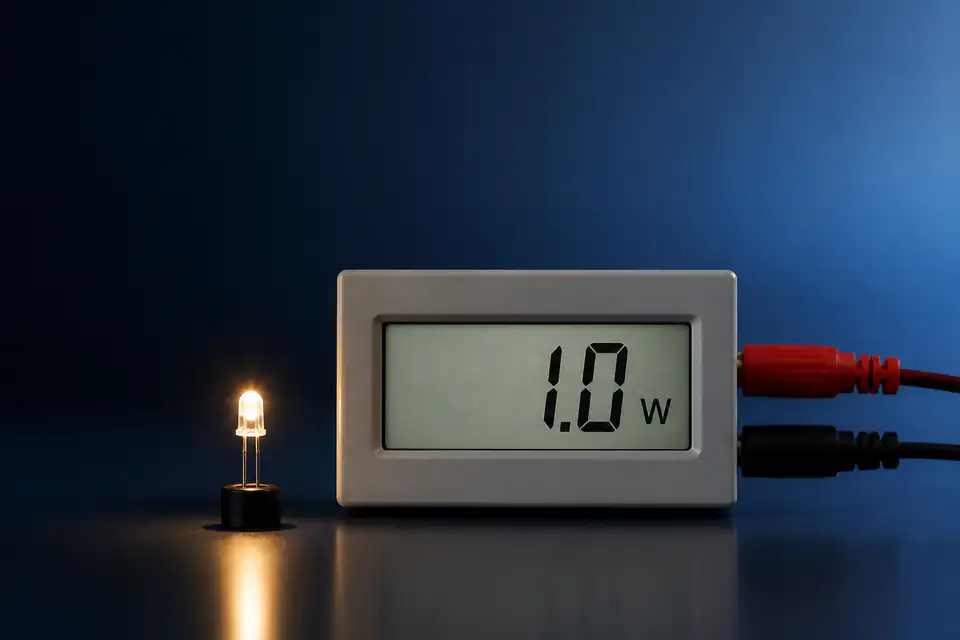
Both sides describe power, or how quickly energy is transferred. One watt is not equal to 3.412 BTU as a standalone energy quantity. If a one-watt load operates for one hour, it uses one watt-hour of energy, which is approximately 3.412142 BTU.
Why the Answer Uses BTU per Hour
A watt is a power unit. One watt means one joule of energy transferred every second. A British thermal unit is an energy unit: it measures a quantity, not how quickly that quantity moves. BTU per hour (BTU/hr or BTUH) adds a time denominator, turning the energy unit into a power or heat-transfer-rate unit.
A valid conversion must compare like physical quantities. Watts can be compared directly with BTU/hr because both answer “how fast?” Watt-hours can be compared with BTU because both answer “how much?” Removing the time basis is like comparing speed with distance: the quantities are related, but they are not interchangeable.
One Watt to BTU/hr Formula
BTU/hr = watts × 3.412142
Watts are the source power, BTU/hr is the result, and 3.412142 is the conversion factor in BTU/hr per watt. For one watt:
1 W × 3.412142 BTU/hr per W = 3.412142 BTU/hr
The reverse formula is:
Watts = BTU/hr ÷ 3.412142
Use more digits through a chained calculation and round the final result. For a broader set of examples, see how to convert watts to BTU.
Where the Conversion Factor Comes From
The factor follows from the definitions of the units. One watt equals one joule per second. An hour contains 3,600 seconds, so maintaining one watt for one hour transfers 3,600 joules.
One BTU is approximately 1,055.06 joules. Divide the hourly energy by the joules in one BTU:
3,600 J ÷ 1,055.06 J/BTU ≈ 3.412 BTU
Since that energy was transferred over one hour, the original power rate is about 3.412 BTU/hr. Small differences in the last decimal places can appear when sources round the joule value or use a different formal BTU definition.
Quick Watts-to-BTU/hr Examples
| Watts | Approximate BTU/hr | Example Context |
|---|---|---|
| 1 W | 3.412 | Small continuous load |
| 10 W | 34.121 | LED light or small device |
| 50 W | 170.607 | Light source or electronics |
| 100 W | 341.214 | Electronic equipment |
| 500 W | 1,706.071 | Appliance or low heater setting |
| 1,000 W | 3,412.142 | Resistance-heater input |
| 1,500 W | 5,118.213 | Full setting on many space heaters |
Values are rounded to three decimal places. The context column is illustrative, not a device specification. The table expresses equivalent power; it does not claim that every electrical input becomes useful heating or cooling output.
One Watt Compared with Other Energy and Power Units
One Watt in Joules per Second
1 W = 1 J/s. This is the SI definition of a watt.
One Watt in Kilowatts
1 W = 0.001 kW. A kilowatt contains 1,000 watts.
One Watt over One Hour
One watt maintained for one hour transfers one watt-hour (Wh) of energy. Power multiplied by operating time produces an energy total.
One Watt in BTU/hr
1 W ≈ 3.412142 BTU/hr. Both values describe the same power rate.
Watts, Watt-Hours, BTU, and BTU/hr
| Unit | Quantity | What It Describes |
|---|---|---|
| Watt (W) | Power | Energy transfer per second |
| Kilowatt (kW) | Power | 1,000 watts |
| Watt-hour (Wh) | Energy | Power accumulated over time |
| Kilowatt-hour (kWh) | Energy | 1,000 watt-hours |
| BTU | Energy | A quantity of thermal energy |
| BTU/hr | Power | Thermal energy transferred per hour |
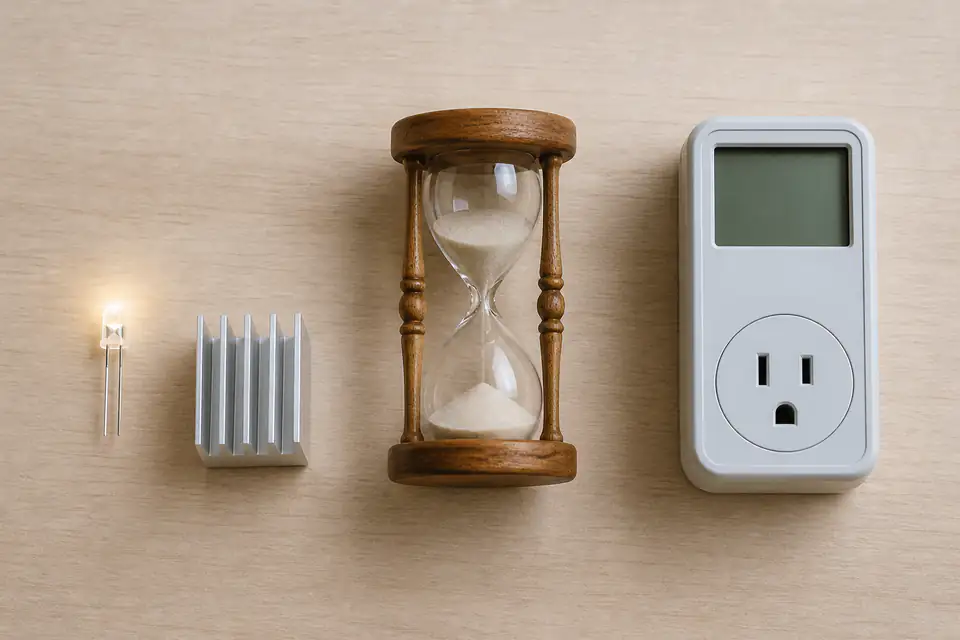
A 100-watt device running for two hours uses 200 watt-hours of energy: 100 W × 2 h = 200 Wh. The 100 W rating describes instantaneous power; 200 Wh describes the total over that runtime. The difference between BTU and watts follows the same energy-versus-power distinction.
What Does One Watt Mean in Practical Terms?
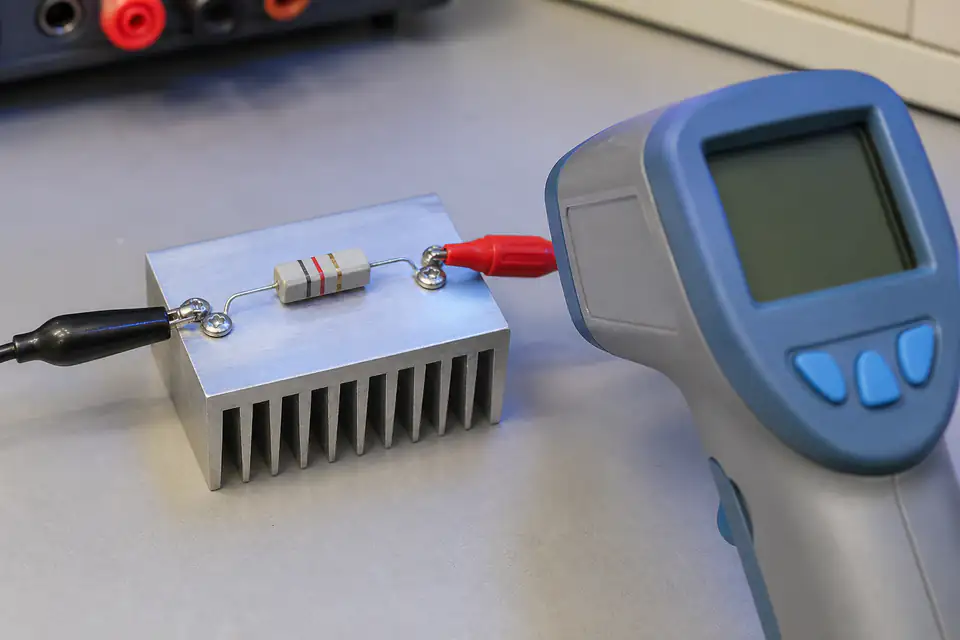
One watt is a small but measurable power rate. It may resemble a low standby load, indicator, sensor, or part of a small communication device, though actual product specifications vary. Electronics also release some input energy as heat, so a continuous one-watt load has a thermal equivalent of 3.412142 BTU/hr.
A small continuous load accumulates over time. One watt running for 24 hours uses 24 Wh; over 30 such days it uses 720 Wh, or 0.72 kWh. That is why runtime is required before a power rating can become an energy or electricity-cost figure.
Does One Electrical Watt Always Produce 3.412 BTU/hr of Heat?
The unit conversion always makes one watt equivalent to 3.412142 BTU/hr of power. The useful output of a device is a separate question. Input energy may appear as heat, light, motion, sound, cooling, stored energy, or a combination. Some output can also leave the space being measured.
A resistance heater converts nearly all its input into heat within the room. Electronics eventually release much of their input as heat in their surroundings, but may first do useful work. Air conditioners and heat pumps move heat, so their thermal heating or cooling output can exceed their electrical input. Equipment efficiency and system boundaries determine the practical interpretation.
Using the Conversion for Heaters
One watt of resistance-heater input corresponds to about 3.412 BTU/hr of heat rate indoors. Therefore, 1,000 W corresponds to about 3,412 BTU/hr and 1,500 W to about 5,118 BTU/hr. The detailed 1,500-watt heater conversion also covers energy cost, amperage, room conditions, and safety.
Rated output does not promise a particular room temperature. Thermostat cycling changes average energy use, while insulation, climate, air leakage, windows, and room size determine the heating load.
Using the Conversion for Air Conditioners and Heat Pumps
An AC rating in BTU/hr describes cooling capacity. Converting it to thermal watts restates that capacity; it does not reveal electrical input. Heat pumps can deliver more thermal output than their input because they transport heat. EER or COP can connect rated capacity to power use under stated conditions, while the nameplate or official specifications provide model-specific input. See BTU to watts for air conditioners for the full distinction.
Common Mistakes
- Writing 3.412 BTU. Use 3.412 BTU/hr for the one-watt power conversion.
- Treating watts as energy. Watts describe a rate; multiply by time for energy.
- Confusing watt-hours with watts. Watt-hours accumulate energy over a duration.
- Equating BTU and BTU/hr. The first is energy and the second is power.
- Reversing the operation. Multiply watts by 3.412142; divide BTU/hr by it.
- Calling the thermal equivalent electrical use. Check device input and efficiency.
- Rounding too early. Retain enough digits until the final result.
- Mixing kW with kWh. Kilowatts are power; kilowatt-hours are energy.
- Ignoring runtime. Cost and energy require operating time.
- Mixing hourly, minute, and second rates. Match the source time denominator.
Related Conversions
For energy conversions, convert BTU to watt-hours or convert BTU to joules. Use BTU to kilowattsfor larger power ratings. If a source uses a different time basis, choose the dedicated BTU per minute to watts or BTU per second converter rather than treating the value as BTU/hr.
Frequently Asked Questions
How many BTU/hr are in one watt?
One watt equals approximately 3.412142 BTU/hr.
Is one watt equal to 3.412 BTU?
Not by itself. One watt is a power rate equal to about 3.412 BTU/hr. One watt-hour is the energy quantity equal to about 3.412 BTU.
How many watts are in one BTU/hr?
One BTU/hr equals approximately 0.293071 watts.
Why does the conversion include per hour?
Because watts measure power. Adding an hour denominator converts the BTU energy unit into the comparable power unit BTU/hr.
Is a watt a unit of energy?
No. A watt measures power. A watt-hour measures energy.
How many BTU/hr are in 100 watts?
100 W × 3.412142 = 341.2142 BTU/hr, or approximately 341.214 BTU/hr.
Can I use this conversion for a heater?
Yes. It gives the heat-rate equivalent, which closely represents full-power indoor output for an electric resistance heater.
Can I use this conversion for an air conditioner?
Yes, to compare cooling capacity units. It does not calculate the AC’s electrical draw.
What is one watt-hour in BTU?
One watt-hour equals approximately 3.412142 BTU. This is an energy conversion, unlike watts to BTU/hr.
What is the difference between a watt and a BTU?
A watt measures power, while a BTU measures energy. BTU/hr is the power unit comparable to watts.
Conclusion
One watt equals approximately 3.412142 BTU/hr. Watts and BTU/hr both describe power, while watt-hours and BTU describe energy. Keeping the time basis matched prevents the most common conversion error. Use the main calculator for larger values or reverse the formula by dividing BTU/hr by 3.412142.
Related Blog Posts
- How to Convert Watts to BTU
Apply the conversion factor to any watt value.
- How Many BTU Is 1,500 Watts?
See the conversion in a practical space-heater example.
- BTU vs Watts: What’s the Difference?
Compare energy, power, capacity, and consumption.
- BTU to Watts Conversion Chart
Look up common values in both power units.